Christian Living
Circumcision and Baptism: See the Difference?
Why the Reformed covenant argument for infant baptism ultimately fails
[This is a short study for our young and new Christian friends in our church, which we hope will be a blessing to others.]
I understand why the Reformed argument for infant baptism is persuasive. It seeks to explain Scriptures, and is not simply tradition. Their argument is covenantal.
God made covenant with Abraham. He included Abraham’s children. He gave them the covenant sign of circumcision. The Covenant of Grace is one. The church is one. Baptism now stands where circumcision once stood. Therefore, unless God has removed believers’ children from the covenant, their children should still receive the covenant sign.
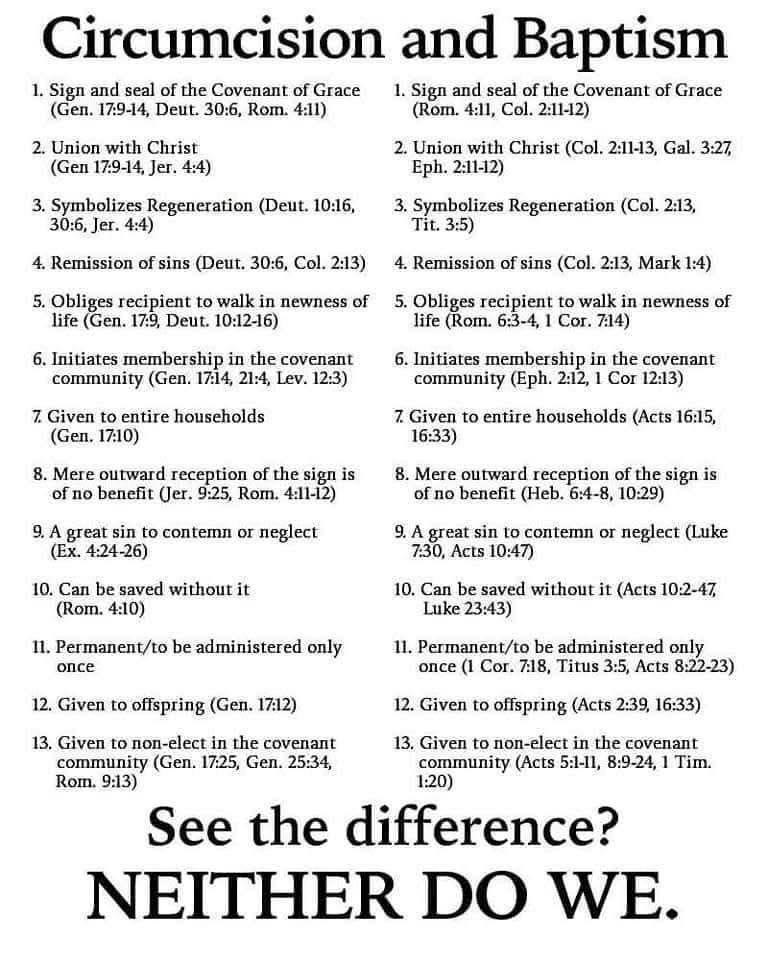
Put circumcision and baptism into two neat columns and the case can look formidable. Both speak of cleansing. Both point to spiritual realities. Both concern covenant membership. Both are signs. Both can be received outwardly without saving benefit. So, the argument goes, See the difference? Neither do we.
The following image is often distributed by Paedobaptists on social media, which can look convincing at the first glance.
But that is exactly where we need to slow down.
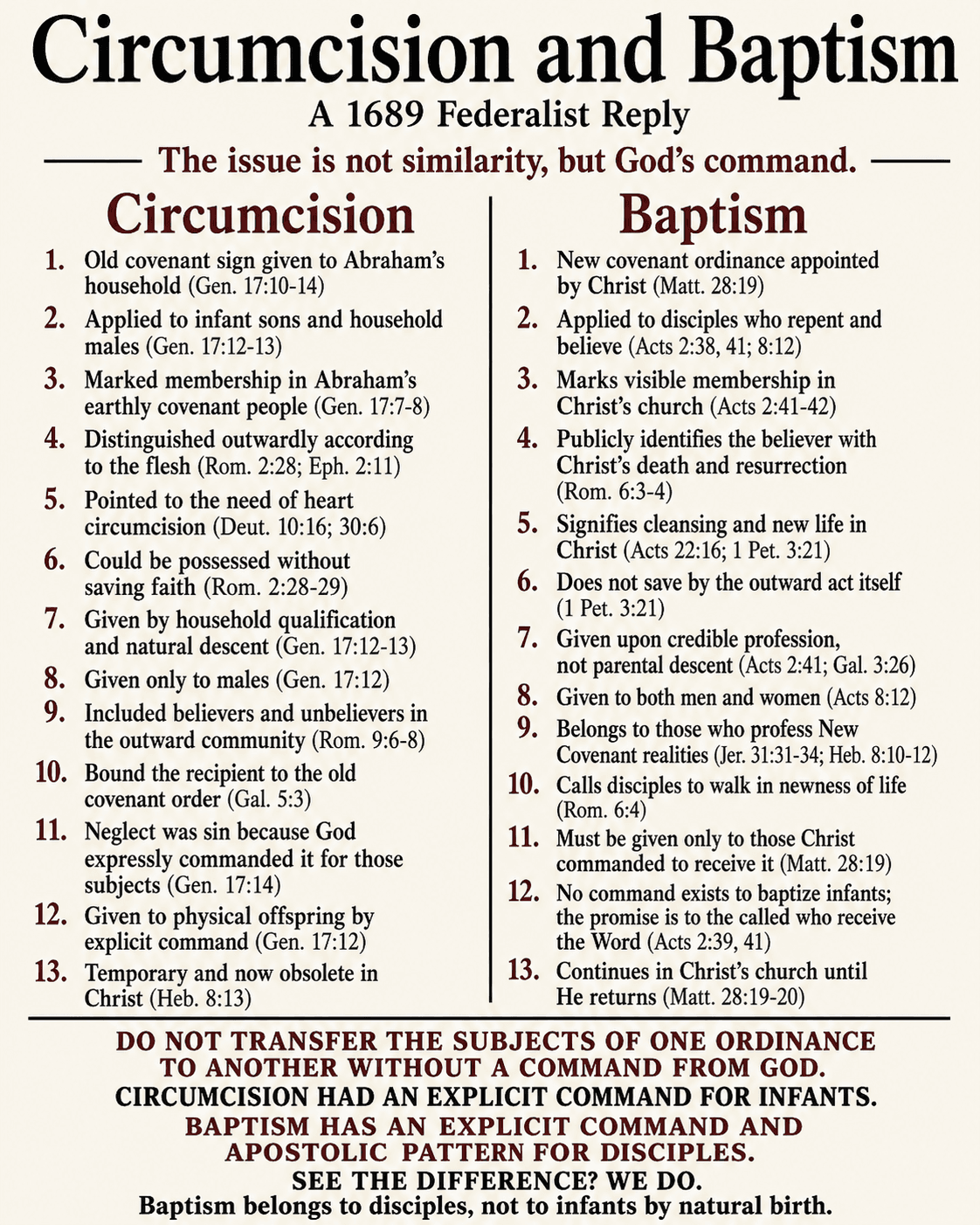
The issue is not whether circumcision and baptism have similarities. Of course they do.
The real question is this:
Who did God command to receive circumcision, and who did Christ command to receive baptism?
The meaning of an ordinance does not by itself tell us its proper subjects. God’s institution does.
That distinction changes the whole discussion.
Let us hear the strongest paedobaptists
It is worth noticing that some of the greatest defenders of infant baptism have openly admitted that the New Testament gives neither an explicit command nor an unmistakable example of infant baptism.
B. B. Warfield, one of the more prominent Presbyterian theologians America produced, admitted that “there is no express command to baptize infants in the New Testament, no express record of the baptism of infants.” [1] He did not become Baptist. His answer was that the warrant is found in covenant continuity from the Old Testament.
John Murray was equally plain. He acknowledged the absence of an express command or proven apostolic case, then argued:
“The evidence for infant baptism falls into the category of good and necessary inference.” [2]
That is an important admission.
It means that the real battle is not over some forgotten verse saying, “Baptise your babies.” There is no such verse.
The question is whether infant baptism really is a necessary inference or deduction from covenant theology.
I do not believe it is.
Reformed Baptists believe covenant theology
First, let us clear away a common misunderstanding.
The historic Particular Baptist position is not dispensationalism dressed in Reformed clothing. We do not believe Old Testament believers were saved differently. Abraham was justified by faith. David knew the forgiveness of sins. Moses esteemed “the reproach of Christ greater riches than the treasures in Egypt” (Hebrews 11:26).
There has always been one Saviour and one gospel.
The 1689 Baptist Confession says that the Covenant of Grace was first revealed after the Fall and then unfolded “by farther steps” until its full discovery in the New Testament. It also says that every fallen sinner who has ever been saved has received life through the grace of that covenant. [3]
So the Baptist is not tearing the Bible in half.
But neither does he flatten every covenant into one covenant with merely different decorations.
Noah, Abraham, Moses and David belong to one unfolding history of redemption, but the covenants made with them have particular promises, signs, purposes and subjects. They point forward. They carry the promise. They prepare the road for Christ.
The road is not the destination.
The shadow is not the body.
And the covenant made in Christ’s blood is not simply Sinai with the furniture rearranged.
Start where circumcision starts
The paedobaptist argument usually turns to Romans 4:11:
“And he [Abraham] received the sign of circumcision, a seal of the righteousness of the faith which he had yet being uncircumcised.”
Quite right.
Circumcision had profound spiritual meaning.
But notice carefully whose faith Paul is describing. Abraham’s.
Abraham believed before he was circumcised.
But eight-day-old Isaac did not first demonstrate Abraham’s faith and then receive circumcision. Ishmael was circumcised. Abraham’s male servants were circumcised.
Why?
Because God said:
“And he that is eight days old shall be circumcised among you, every man child in your generations, he that is born in the house, or bought with money” (Genesis 17:12).
Here is the principle that gets lost in many discussions:
The spiritual meaning of circumcision did not determine who received circumcision. God’s command determined who received it.
A wedding ring can represent love, fidelity, covenant and union. None of those meanings tells you to put a wedding ring on every child born to married parents. You must know whom the institution belongs to.
So also with God’s ordinances.
Circumcision could point towards heart circumcision, righteousness by faith and separation unto God. Yet the recipient rule was explicit: Abrahamic household males, including infant sons.
Now ask the obvious question.
If baptism simply takes over circumcision’s recipients, why are females baptised?
Why is there no eighth-day rule?
Why are a Christian man’s servants not baptised because they belong to his household?
The paedobaptist will answer, correctly, that the New Covenant changes some things.
Exactly.
Then the New Testament must tell us what has changed and who now receives its ordinance.
We cannot preserve the infant while quietly dropping the sex, age and household-servant qualifications, then claim that covenant continuity itself decided the matter.
Who are Abraham’s children now?
This is where Galatians 3 becomes very difficult for the infant-baptist position.
Paul does not say: The children of believers are the children of Abraham.
He says:
“Know ye therefore that they which are of faith, the same are the children of Abraham” (Galatians 3:7).
Again:
“For ye are all the children of God by faith in Christ Jesus” (Galatians 3:26).
And finally:
“And if ye be Christ’s, then are ye Abraham’s seed, and heirs according to the promise” (Galatians 3:29).
Paul takes the Abrahamic promises and drives us towards Christ .
Christ is the promised Seed. Those united to Christ are Abraham’s seed.
Romans 9 makes the same distinction painfully clear:
“They which are the children of the flesh, these are not the children of God: but the children of the promise are counted for the seed” (Romans 9:8).
This does not mean that children raised by Christian parents have no privilege. They have enormous privilege.
They hear prayer before they can pray. They hear Scripture before they can read. They are carried to worship. They live under gospel light while millions grow up in darkness.
What an advantage.
But privilege is not the same thing as New Covenant membership .
The question is not whether Christian children are blessed.
The question is whether natural birth to a Christian parent gives a person the right to Christ’s New Covenant ordinance.
Where does the New Testament say that?
The New Covenant really is new
Jeremiah 31 is central:
“Behold, the days come, saith the LORD, that I will make a new covenant” (Jeremiah 31:31).
And God immediately tells us something remarkable about its members:
“They shall all know me, from the least of them unto the greatest of them... for I will forgive their iniquity, and I will remember their sin no more” (Jeremiah 31:34).
Hebrews 8 quotes this passage at length and applies it to Christ’s superior covenant.
Under the old covenantal order there could be people born into the covenant nation who needed to be told, “Know the LORD.” That is, You need to know God, and knowing Him by real experience .
But of those with whom the New Covenant is made, God says:
“They shall all know me.”
Here an extraordinary witness comes from the Puritan, John Owen.
John Owen was a Congregational paedobaptist. We should not pretend otherwise. Yet in his exposition of Hebrews 8 he said:
“Where there is not some degree of saving knowledge, there no interest in the new covenant can be pretended.” [3]
That is so powerful a statement.
Now someone immediately objects: “But Baptist churches contain hypocrites, those who may profess and be baptised, but not truly converted! Simon Magus was baptised!”
Certainly.
But that confuses two things.
There is the constitution of the New Covenant , and there is our fallible administration of the visible church .
We cannot read hearts. We baptise people upon credible profession of faith in Christ and experience of the Spirit’s saving work. Sometimes we are deceived.
Simon Magus professed faith. The church received him. His later conduct exposed him.
That is fundamentally different from deliberately baptising someone who makes no profession at all.
One is an error of human judgement.
The other is a principle of church order.
The question is whether God has commanded the second.
But surely baptism replaces circumcision?
Then comes Colossians 2.
This is perhaps the strongest text for connecting circumcision and baptism, and Baptists should not run away from it.
Paul says believers are:
“circumcised with the circumcision made without hands” (Colossians 2:11).
Then:
“Buried with him in baptism, wherein also ye are risen with him through the faith of the operation of God” (Colossians 2:12).
There certainly is a relationship. But notice which circumcision Paul connects with baptism. Not the physical cutting performed upon an eight-day-old boy.
It is “the circumcision made without hands.”
It is the spiritual reality to which physical circumcision pointed.
And Paul’s language moves through union with Christ, burial, resurrection and faith .
Colossians 2 therefore gives us:
spiritual circumcision, Christ, baptism, resurrection, faith.
What it does not give us is:
circumcision was given to infants, therefore baptise infants.
The theological connection is real.
The transfer of subjects is assumed.
That is precisely what still needs proving.
“The promise is unto you, and to your children”
Then Acts 2:39 is brought forward:
“For the promise is unto you, and to your children...”
It sounds decisive until we finish Peter’s sentence:
“and to all that are afar off, even as many as the Lord our God shall call.”
And then we keep reading:
“Then they that gladly received his word were baptized” (Acts 2:41).
Peter does not say:
Those who received the Word, together with their infant children, were baptised.
Luke tells us who were baptised:
“They that gladly received his word.”
Acts 2:39 is a glorious declaration of the breadth of God’s promise. Jews, their descendants, those far away, all whom the Lord calls.
But it never says that a parent’s faith gives an infant an immediate right to baptism.
That conclusion has been brought to the verse. It has not been taken from it.
What about household baptisms?
We should be careful here.
We cannot prove Lydia had no infant in her house. (Acts 16:14-15)
Neither can the paedobaptist prove that she did.
That means Lydia’s household cannot carry the weight often placed upon it.
Interestingly, the great Anglican commentator Henry Alford conceded that “no inference for infant-baptism is hence deducible” from Lydia’s case. He then defended the practice from covenant continuity instead.[4]
Again, that tells us where the actual argument lies.
Elsewhere the household passages lean in the Baptist direction.
The Philippian jailer had the Word preached “to all that were in his house” (Acts 16:32). The jailer “rejoiced, believing in God with all his house” (Acts 16:34).
Crispus “believed on the Lord with all his house” (Acts 18:8).
Then Luke gives the familiar pattern:
“many of the Corinthians hearing believed, and were baptized” (Acts 18:8).
Hearing.
Believing.
Baptism.
That pattern keeps appearing.
“But now are they holy”
First Corinthians 7:14 is another favourite:
“else were your children unclean; but now are they holy.”
Whatever this holiness means, we must read the whole verse.
Paul also says:
“the unbelieving husband is sanctified by the wife.”
If relational sanctification automatically creates baptismal entitlement, what shall we do with the unbelieving husband?
The verse clearly teaches that living in a household touched by Christian faith brings a real set-apartness and privilege.
Amen.
But Paul says nothing about baptism.
We must not turn holy into baptised covenant member simply because our system requires it.
The Corinthian passage is speaking of the legitimacy of the children, because of the validity of the marriage before God. The children are not illegitimate.
Even paedobaptists know where the weakness lies
Philip Schaff, the great Reformed church historian, stated plainly:
“the New Testament contains no express command to baptize infants.” [5]
Warfield admitted there is no express command and no express record.
Murray conceded the same and rested his case upon “good and necessary inference”.
Alford admitted that Lydia’s household does not itself establish infant baptism.
None of these men became Baptist because of those admissions. That is not the point.
The point is that infant baptism stands or falls with the covenantal inference .
So we must ask whether that inference is actually necessary.
I believe Scripture shows that it is not.
The paedobaptist says, “Children were once given the covenant sign. Where did God put them out?”
I would turn the question around.
Where did Christ command the church to baptise a person because his father or mother believes?
That question will not go away.
Follow Christ’s institution
The Great Commission is a disciple-making commission:
“Go ye therefore, and teach [make disciples through teaching] all nations, baptizing them...” (Matthew 28:19).
Then Acts shows us how the apostles understood it.
“They that gladly received his word were baptized” (Acts 2:41).
“When they believed Philip preaching... they were baptized, both men and women” (Acts 8:12).
Peter asks:
“Can any man forbid water, that these should not be baptized, which have received the Holy Ghost as well as we?” (Acts 10:47).
And:
“many of the Corinthians hearing believed, and were baptized” (Acts 18:8).
That is why the 1689 Baptist Confession of Faith describes those who actually profess repentance, faith and obedience to Christ as “the only proper subjects of this ordinance.” [6]
We do not say that baptism is merely a human testimony.
It signifies magnificent things: union with Christ, His death and resurrection, remission of sins and newness of life.
But precisely because it signifies such things, we administer it according to Christ’s institution.
Not according to sentiment.
Not according to ecclesiastical history.
Not even according to a beautiful theological parallel unless Scripture itself warrants the inference.
Circumcision had an explicit divine command for infants.
Baptism has an explicit apostolic pattern for professing disciples.
Similarities? Certainly.
Identical recipients? Scripture never says so.
And the church has no authority to improve upon the instructions of its King.
Endnotes
B. B. Warfield , “The Polemics of Infant Baptism”, originally published in The Presbyterian Quarterly and later reprinted in Studies in Theology , in The Works of Benjamin B. Warfield , vol. 9, especially p. 399.
John Murray , Christian Baptism , chapter V, “Objections to Infant Baptism”, p. 72 in the Baker edition. Murray acknowledges the absence of an explicit command or proven case and bases his defence upon “good and necessary inference”.
John Owen , An Exposition of the Epistle to the Hebrews , exposition of Hebrews 8:11.
Henry Alford , The Greek Testament , commentary on Acts 16:15.
Philip Schaff , History of the Christian Church , vol. 1, section on baptism. ( Christian Classics Ethereal Library (opens in a new tab) )
The Second London Baptist Confession of Faith (1689) , chapters 7 and 29, especially 7.3 and 29.1–2.
Further Study - Introductory Resources
The Baptism of Disciples Alone - Fred Malone ( Founders Press (opens in a new tab) )
The Children of Abraham - David Kingdon ( Grace Publications (opens in a new tab) )
Should Babies be Baptized? - TE Watson (Evangelical Press)
From Paedobaptism to Credobaptism - W. Gary Crampton ( Reformed Baptist Academic Press (opens in a new tab) )
The Distinctiveness of Baptist Covenant Theology (Revised Edition) - Pascal Denault ( Buy (opens in a new tab) )
Excellent Podcasts from International Reformed Baptist Seminary (Spotify):
Believer's Baptism part 1: Introduction (opens in a new tab)
Believer's Baptism Part 2: Argued from the New Testament (opens in a new tab)
Believer's Baptism part 3: The Old Covenant Baptism (opens in a new tab)
Believer's Baptism part 4: Argued from the doctrine of the Covenants (opens in a new tab)
Believer's Baptism part 5: Considered within Church History (opens in a new tab)
Believer's Baptism part 6: A critique of the Reformed Paedobaptist position (opens in a new tab)
Believer's Baptism part 7: The due administration (opens in a new tab)
Written by Pooyan Mehrshahi.
Follow on Substack (opens in a new tab)A warm invitation
Come and Hear the Bible Preached
Join us at Providence Baptist Chapel in Cheltenham this Sunday at 11:00 am and 5:30 pm.
Keep reading
Related articles
Did God Ever Put the Children Out?
One church, a New Covenant, and the argument from church history

I am So Discouraged!
Discouragement has many addresses. It may sit beside a hospital bed, in the empty chair of bereavement, in a marriage that has broken, in the loneliness of singleness, in the shame of a teenager who feels he has…

When God Does Not Answer
“How long wilt thou forget me, O LORD? for ever? how long wilt thou hide thy face from me?” (Psalm 13:1). There are few trials more painful than unanswered prayer. It is one thing to suffer; it is another to suffer…